







Best Nootropics for Productivity in 2026
Nootropics are supplements designed to boost focus, memory, and mental energy. With workplace demands increasing, professionals are turning to these tools to stay sharp and manage stress. However, not all nootropics are equally effective, and transparency in labeling is more important than ever. Here's what you need to know:
-
Top Picks for Focus and Productivity:
- Citicoline: Improves attention and mental energy.
- L-Theanine: Combines with caffeine for calm focus.
- Bacopa Monnieri: Supports memory over time.
- Rhodiola Rosea: Reduces fatigue and stress.
- Lion's Mane Mushroom: Promotes long-term cognitive health.
-
How They Work:
- Boost neurotransmitters like dopamine and acetylcholine.
- Enhance brain energy and blood flow.
- Reduce stress by balancing cortisol levels.
-
Key Insights:
- Timing matters: Take stimulating nootropics in the morning and calming ones before bed.
- Stacking (e.g., caffeine + L-Theanine) can improve results.
- Regular use and cycling prevent tolerance and maintain effectiveness.
Nootropics can complement good habits like sleep and exercise, helping you tackle demanding tasks with clarity and focus.
How Nootropics Improve Workplace Performance
Nootropics enhance workplace productivity by improving brain energy, focus, memory, and stress management. They work by supporting the brain's natural mechanisms for attention, memory, and resilience, helping you stay sharp and make better decisions during demanding tasks.
Maintaining Focus and Energy
Although the brain makes up only about 2% of your body weight, it consumes roughly 20% of your daily energy. When you're tackling a challenging project, your neurons demand extra fuel to keep up. Nootropics like Creatine help by aiding ATP regeneration - the energy source your brain relies on during intense mental work.
Key neurotransmitters such as dopamine, norepinephrine, and acetylcholine play a vital role in maintaining focus and alertness. For instance, research from 2008 revealed that combining 97 mg of caffeine with 40 mg of L-theanine significantly improved attention-switching accuracy. This combination created a state of "calm alertness", avoiding the jittery side effects often linked to caffeine alone.
Another effective nootropic, L-Tyrosine, serves as a precursor to dopamine and norepinephrine. Studies suggest that doses of 500–2,000 mg of L-Tyrosine can help preserve working memory and cognitive flexibility, even under extreme stress.
Beyond improving focus, nootropics also play a role in strengthening memory and learning abilities.
Supporting Memory and Learning
Nootropics such as Citicoline and Alpha-GPC enhance memory by increasing choline availability, which boosts acetylcholine production. This improves the "signal-to-noise ratio" in neural pathways, making memory formation more efficient.
Some nootropics also work on a deeper, structural level. For example, Lion's Mane mushroom stimulates Nerve Growth Factor (NGF), which helps maintain and repair neurons. In a double-blind study conducted in Japan, adults aged 50–80 with mild cognitive impairment showed marked improvements in cognitive function after taking 250 mg of Lion's Mane three times daily for 16 weeks.
Meanwhile, Bacopa monnieri enhances memory by encouraging dendrite branching, which allows nerve cells to process and store information more effectively. However, it requires consistent use for 8–12 weeks to see measurable results. Additionally, caffeine has been shown to improve memory consolidation by about 30% when taken after studying, compared to a placebo.
Reducing Stress and Supporting Better Decisions
Stress can cloud judgment and derail productivity, but nootropics help by modulating cortisol levels and balancing neurotransmitter systems. Adaptogens like Rhodiola Rosea and Ashwagandha regulate the hypothalamic-pituitary-adrenal (HPA) axis, preventing the "brain fog" that often accompanies high-stress situations.
Rhodiola Rosea is particularly effective at combating mental fatigue and burnout, enabling sustained cognitive performance during long hours. Unlike stimulants, which often lead to crashes, Rhodiola builds fatigue resistance gradually over several days of use. On the other hand, L-Theanine promotes a state of relaxed focus by increasing alpha brainwave activity and supporting GABA systems, helping to reduce anxiety and mental distractions during high-pressure tasks.
When stress is under control and neurotransmitters are balanced, you’re better equipped to analyze options, weigh consequences, and make sound decisions - skills that are crucial for thriving in the workplace.
| Nootropic | Primary Workplace Benefit | Onset Time |
|---|---|---|
| Citicoline | Sustained attention and mental energy | 1–2 weeks |
| L-Tyrosine | Focus under extreme stress/deadlines | 1–2 hours |
| Rhodiola Rosea | Fatigue resistance and burnout relief | 3–5 days |
| Bacopa Monnieri | Information retention and memory recall | 8–12 weeks |
| L-Theanine | Calm focus; reduces caffeine jitters | 30–45 minutes |
sbb-itb-7567710
Top Nootropic Ingredients for Productivity in 2026
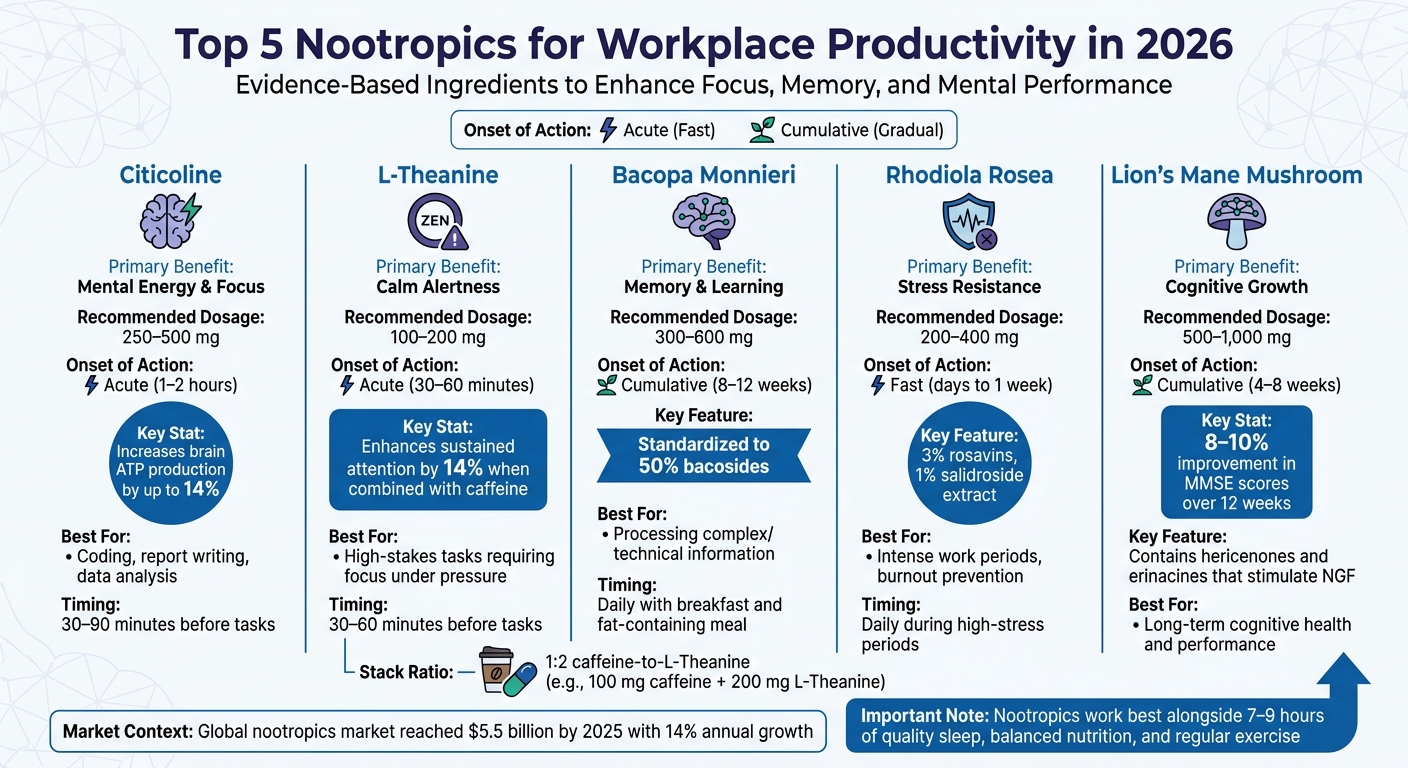
Top 5 Nootropics for Workplace Productivity: Benefits, Dosage, and Onset Time Comparison
As the demand for sustained cognitive performance grows, so does the interest in nootropics. By 2025, the global nootropics market reached $5.5 billion, with an annual growth rate of 14% - a clear sign that professionals are seeking reliable alternatives to caffeine for better mental performance. This shift reflects a preference for transparency and clinically supported options. Below are some of the most well-researched nootropic ingredients to help boost workplace productivity.
Citicoline for Mental Energy and Focus
Citicoline is a powerhouse for brain energy, supporting neurotransmitter production and energy metabolism. It provides choline for acetylcholine synthesis while cytidine converts to uridine, aiding in membrane repair. Studies show that citicoline can increase brain ATP production by up to 14%. A 28-day trial revealed that doses of 250–500 mg daily improved sustained attention in healthy adults. To maximize its benefits, take citicoline 30–90 minutes before diving into tasks like coding, report writing, or data analysis.
L-Theanine for Calm Alertness
L-Theanine, found naturally in green tea, promotes a state of "alert calm" by enhancing alpha brainwave activity. A 2026 study published in the European Journal of Nutrition demonstrated that a multi-ingredient supplement containing L-Theanine improved selective attention and executive function, offering effects comparable to 150 mg of caffeine - without raising blood pressure. Combining 40 mg of caffeine with 100 mg of L-Theanine has been shown to enhance sustained attention by 14%, making it ideal for high-stakes tasks.
"L-Theanine... takes the edge off caffeine without dulling the cognitive benefits." - AJ Keller, CEO, Neurosity
For tasks requiring focus under pressure, try a 1:2 caffeine-to-L-Theanine ratio (e.g., 100 mg caffeine to 200 mg L-Theanine), taken 30–60 minutes in advance.
Bacopa Monnieri for Memory and Learning
Bacopa Monnieri is a nootropic with long-term benefits, particularly for memory and processing complex information. Its effects build over time, typically taking 8 to 12 weeks of consistent use to fully manifest. Look for extracts standardized to at least 50% bacosides, and stick to a daily dose of 300–600 mg. This ingredient is especially useful for professionals dealing with intricate or technical information regularly.
Rhodiola Rosea for Stress Resistance
Rhodiola Rosea is known for helping the body adapt to stress, reducing mental fatigue and burnout. A standardized extract (3% rosavins, 1% salidroside) taken in doses of 200–400 mg daily can deliver noticeable improvements in clarity and resilience within days. This makes it a go-to option during intense work periods when mental stamina is crucial.
Lion's Mane Mushroom for Cognitive Growth
Lion's Mane Mushroom supports neural growth by stimulating Nerve Growth Factor (NGF) through its active compounds, hericenones and erinacines. A 2020 clinical trial found that participants taking Lion's Mane extract improved their Mini-Mental State Exam (MMSE) scores by 8–10% over 12 weeks compared to a placebo. While its effects are cumulative - usually noticeable after 4–8 weeks - a daily dose of 500–1,000 mg (with some studies using up to 3,000 mg) can help build a strong foundation for long-term cognitive health and performance.
| Ingredient | Primary Benefit | Recommended Dosage | Onset of Action |
|---|---|---|---|
| Citicoline | Mental Energy & Focus | 250–500 mg | Acute (1–2 hours) |
| L-Theanine | Calm Alertness | 100–200 mg | Acute (30–60 minutes) |
| Bacopa Monnieri | Memory & Learning | 300–600 mg | Cumulative (8–12 weeks) |
| Rhodiola Rosea | Stress Resistance | 200–400 mg | Fast (days to 1 week) |
| Lion's Mane | Cognitive Growth | 500–1,000 mg | Cumulative (4–8 weeks) |
How to Use Nootropics for Workplace Success
Using nootropics effectively involves paying attention to timing, combining the right compounds, and cycling them to maintain their benefits.
Timing and Dosage Strategies
Your brain tends to perform best for complex tasks between 8:00 AM and 10:00 AM, thanks to natural cortisol peaks. This is an ideal window for taking stimulating nootropics like citicoline or caffeine-based stacks, which typically reach their peak effect within 30–90 minutes. To avoid disrupting your sleep, steer clear of stimulating nootropics after 2:00 PM, as caffeine’s half-life of 5–6 hours can interfere with rest.
For calming nootropics such as Magnesium Glycinate or L-theanine, take them 30–60 minutes before bedtime to help promote deep, restorative sleep. Meanwhile, cumulative nootropics like Bacopa Monnieri and Lion’s Mane work best when taken daily with breakfast and a fat-containing meal to aid absorption. These compounds typically show results over 4–12 weeks of consistent use.
By aligning nootropic timing with your body’s natural rhythms, you can maximize their effectiveness.
Combining Nootropics for Better Results
Stacking nootropics allows you to target multiple cognitive functions at once. A popular choice is the 1:2 caffeine-to-L-theanine ratio - for example, 100 mg of caffeine paired with 200 mg of L-theanine. This combination promotes focused energy without the jittery side effects.
For particularly stressful workdays, adaptogens like Rhodiola Rosea or Ashwagandha can help. A 2021 study demonstrated that 300 mg of Ashwagandha extract daily reduced cortisol levels by 27.9% over 90 days. If you’re new to nootropics, it’s a good idea to start with a simple two-ingredient stack. Once you’ve established a baseline, you can experiment with adding other compounds.
Preventing Tolerance and Energy Crashes
Even with an optimized stack, cycling is essential to maintain effectiveness. For stimulants like caffeine, tolerance can develop in as little as 2–3 weeks of daily use. To avoid this, try a "5 days on, 2 days off" schedule. For racetams, a "4 weeks on, 1 week off" approach works well. Similarly, adaptogens like Rhodiola Rosea should be cycled - use them for 4–6 weeks, then take a 2-week break to maintain their benefits.
"The best nootropic is the one you can prove is working. Your own data is the only proof that counts." - Phuc Doan, Author
To evaluate your stack’s effectiveness, track measurable outcomes like focus duration or error rates for at least two weeks before and after starting a new regimen. And don’t forget: no supplement can replace the benefits of 7–9 hours of quality sleep. Interestingly, a 2024 survey found that about 30% of tech workers use cognitive enhancement supplements alongside coffee.
Conclusion
With workplace productivity facing intense challenges, professionals are searching for smarter ways to stay focused, manage stress, and deliver high-quality work. Nootropics provide a research-backed method to support the brain’s natural functions - helping with everything from neurotransmitter balance to energy production at the cellular level, which are essential for sustained mental performance.
Studies highlight measurable benefits from these compounds. Ingredients like Citicoline, Ashwagandha, Lion’s Mane, and Bacopa Monnieri have shown consistent results in boosting cognitive function when used regularly. Paired with good sleep, balanced nutrition, and regular exercise, nootropics can amplify the brain’s natural abilities.
"Nootropics are not meant to replace sleep, discipline, or good habits. What they attempt to do... is assist the biological systems that allow the brain to operate efficiently." - SAP Nutrition
The key is finding the right solution for your needs. Whether it’s combating mid-day brain fog, building resilience under stress, or enhancing memory for demanding tasks, a tailored nootropic stack can deliver real results. Start with a baseline, monitor your progress, and adjust based on what the data shows.
NutriFitt’s CODEX Nootropic stands out as a premium option, offering a formula designed to enhance focus, memory, and mental endurance. When combined with thoughtful timing and consistent use, nootropics can help tackle the productivity demands of today’s fast-paced world.
FAQs
Which nootropic should I start with for focus at work?
Citicoline (CDP-Choline) is a solid option for sharpening focus on the job. Studies suggest it can help improve memory and mental processing speed, which might make it a useful tool for staying productive. Be sure to check with a healthcare provider before adding any supplement to your routine.
How do I know if a nootropic is actually working for me?
To figure out whether a nootropic is working for you, start by tracking your usual cognitive performance for at least two weeks before using it. Keep an eye on things like how long you can stay focused, how often you get distracted, and any noticeable shifts over time. Pay close attention to how you feel - are you more focused, less tired, or in a better mood? Also, take note of any side effects. Regular self-checks can help you determine if the nootropic is delivering the results you’re looking for.
Are nootropics safe to take every day with coffee?
Some nootropics are often regarded as safe for daily use, but mixing them with coffee can lead to different effects depending on the individual. Since everyone’s body reacts differently, it’s a good idea to check with a healthcare professional first to understand potential interactions and how your body might respond.
Latest Posts

How Ashwagandha Supports Testosterone Levels
10 Best Natural Pre-Workout Ingredients

Best Electrolyte Supplements for Fitness Goals
Best Nootropics for Productivity in 2026

Top 5 Sleep Hygiene Practices for Athletes

5 Best Pre-Workouts for Pump

The 30-Minute Body That Beats the 2-Hour One
Short, high-intensity 30-minute workouts can deliver equal or better cardio, strength, and fat-loss results than long sessions.

Checklist for Choosing Clean Label Certified Supplements
Checklist to verify certifications, ingredient transparency, batch COAs, GMP compliance, and bioavailable forms in clean-label supplements.